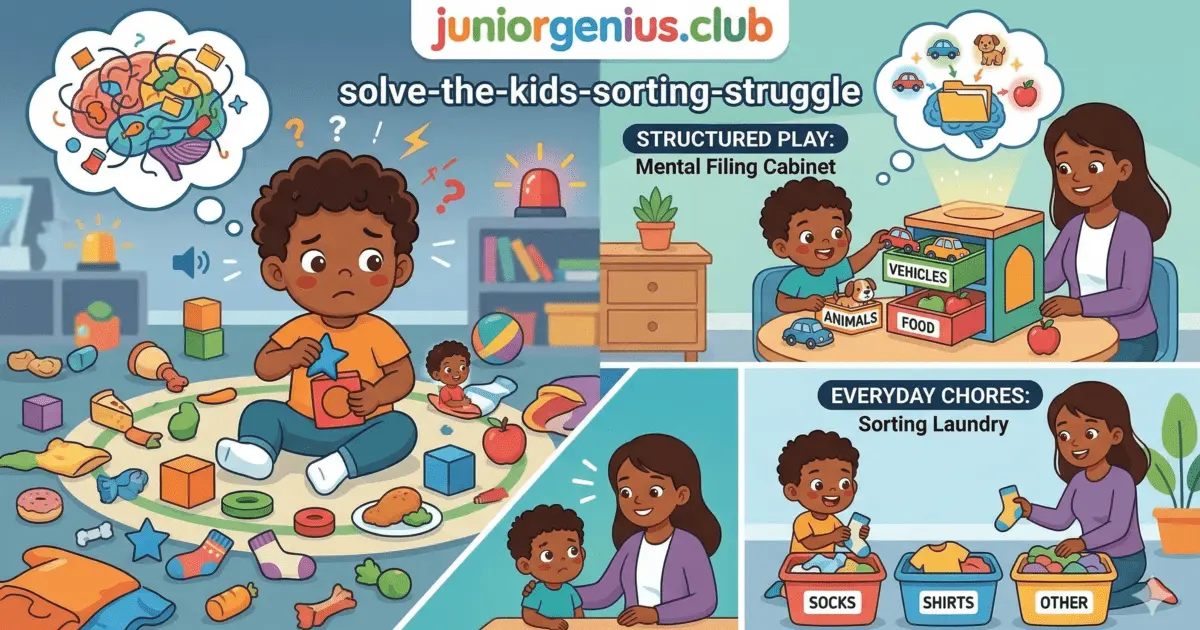
The Sorting Struggle: Why Categorization is the Root of Logical Thought
🧩 Sorting and categorization are far more than just "playing with blocks." They are the foundational building blocks of logical reasoning, mathematical understanding, and even language acquisition. When a child sorts objects, they are essentially learning to organize the world. However, many parents today notice a "Sorting Struggle" in their toddlers—a difficulty in recognizing similarities and differences based on abstract criteria like shape, color, or function.
1. The Problem: Information Overload and Lack of Structure
The problem often stems from the overwhelming amount of unorganized sensory input in a modern child's life. In previous generations, toys were often simpler and followed clear categorical rules (a set of blocks, a set of dolls, a set of cars). Today, many "activity centers" and toy bins are a chaotic mix of shapes, textures, and sounds. While this provides variety, it can sometimes hinder a child's ability to focus on a single attribute for categorization.
The "Sorting Struggle" manifests when a child cannot group objects by a specific rule. For example, if asked to put all the "blue" items together, they might get distracted by the shapes or the textures and fail to complete the task. This lack of categorical focus can lead to difficulties in more complex cognitive tasks later on, such as understanding number sets or grammatical structures in language.
Moreover, the digital world often presents information in a non-linear, non-categorical way. Feeds and playlists are "algorithmic" rather than "categorical." This means children are less likely to see items grouped by their inherent properties, which can delay the development of the brain's "sorting centers."
2. The "Why" and "How": The Cognitive Science of Sorting
Why is sorting so important? Categorization is how the human brain manages information. Without the ability to group items into categories (e.g., "food," "danger," "toy"), the world would be an unintelligible series of unique events. By learning to sort, a child is training their prefrontal cortex to perform "selective attention"—the ability to focus on one feature while ignoring others.
The "How" of categorization involves several complex brain processes. First, the child must perceive the object's attributes. Second, they must form a mental "set" or "rule." Third, they must compare subsequent objects to that rule. This is the beginning of inductive and deductive reasoning. If a child struggles to sort simple shapes, they may later struggle with the abstract "sets" required in algebra or the logical hierarchies in science.
Furthermore, categorization is deeply linked to vocabulary development. Learning the word "apple" is only possible if the child can categorize all different-looking apples into a single mental group. If the sorting mechanism is weak, the child may struggle to generalize words, leading to a slower expansion of their vocabulary.
3. Minimization Strategies: Bringing Order to the Chaos
To help your child overcome the sorting struggle, you need to create opportunities for structured classification in their daily life. Here are some effective strategies:
- Attribute Talk: When playing, talk about the properties of objects. "Look at this red block. It is smooth. Can you find another smooth thing?" This draws their attention to specific categories.
- Laundry Sorting: Involve your toddler in simple chores. Ask them to find all the socks or all the blue shirts. This provides a real-world context for categorization.
- Clear Toy Organization: Instead of one giant toy box, use smaller, clear bins. Label them with a picture of what goes inside (e.g., a bin for cars, a bin for blocks). This reinforces the concept that things belong in groups.
- The "One of These Things is Not Like the Other" Game: Present three objects where two share an attribute and one does not (e.g., two red balls and one blue ball). Ask the child to point to the one that is different.
By integrating these activities into your routine, you are providing the "scaffolding" your child's brain needs to build its own internal filing system.
4. Alternatives: Offline & Online
Building categorization skills can be fun and interactive, whether you're using physical toys or digital tools.
Offline Activities
Nature Sorting: Go for a walk and collect leaves, stones, and twigs. When you get home, ask the child to sort them by type, size, or color. This connects categorization to the natural world.
Shape Sorter Buckets: Classic shape sorters are excellent. They provide immediate physical feedback—if the shape doesn't match the category (the hole), it won't fit. This tactile learning is invaluable.
Button Sorting: If you have a jar of colorful buttons, have your child sort them into an egg carton by color or size. (Note: Always supervise toddlers with small objects to prevent choking.)
Online Alternatives (Kids Scroll)
For a focused digital experience that reinforces these concepts, we recommend:
Ready to start sorting?
Master the art of categorization with our Shape Sorter game on Kids Scroll. Help your child build the foundation of logical thought today in a safe, ad-free environment.
Helping your child master the art of sorting is one of the greatest gifts you can give their developing mind. It's the foundation upon which all future logic and learning will be built. 🌈
Frequently Asked Questions
Why does my child ignore the shapes?
It's common for toddlers to be overwhelmed by color or texture first. Start by sorting items that are identical except for shape to help their brain isolate that specific attribute.
Is sorting related to math?
Absolutely! Sorting is the precursor to understanding sets, patterns, and quantities. Masterful sorting leads to easier grasp of mathematical concepts later on.
Can sorting help with language?
Yes, categorization helps children organize their vocabulary. By grouping objects on Kids Scroll, they are also learning the mental hierarchies needed for complex language.
What if my child mixes up the categories?
That's part of the learning process! If they put a banana in the 'toy' bin, ask them: 'Do we play with this, or do we eat it?'. This gentle correction helps them refine their internal categorical rules.