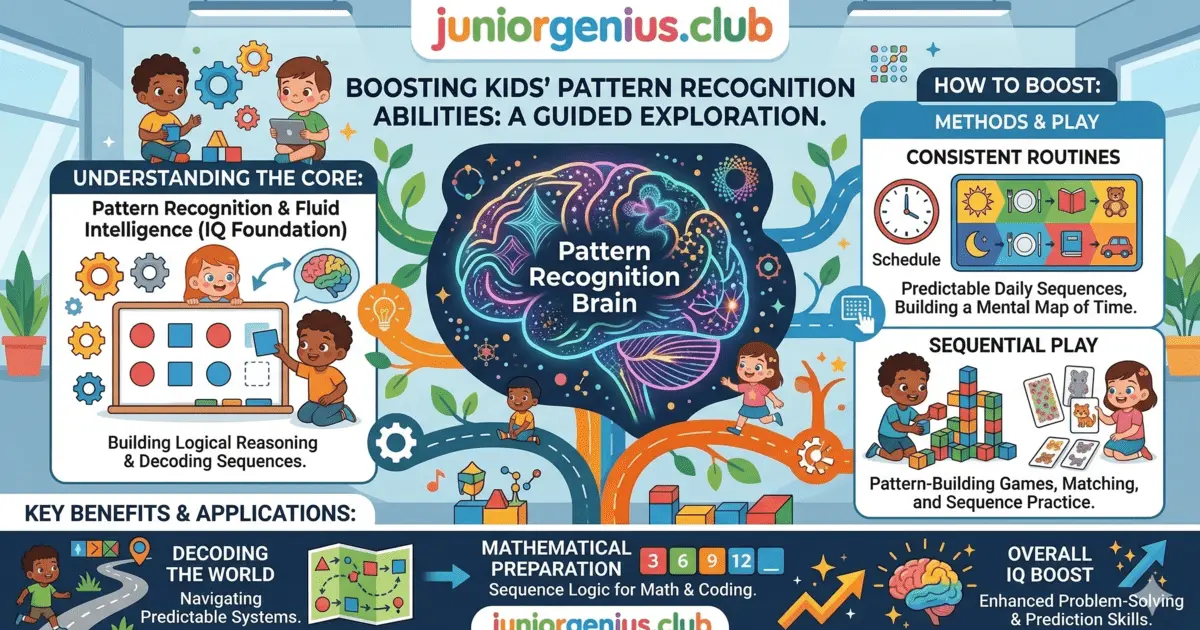
Pattern Recognition: Boosting IQ Through Visual Identification
🔍 Pattern recognition is the ability of the brain to identify repeating sequences, regularities, and relationships within data—in this case, visual data. It is widely considered one of the most critical components of fluid intelligence, the ability to solve new problems without relying on previously acquired knowledge. For a toddler, pattern recognition is the "secret code" that helps them make sense of a complex world.
1. The Problem: The Loss of Sequential Play
The problem in many modern households is the shift away from sequential play. Sequential play involves activities that have a beginning, a middle, and an end, following a logical order. This could be building a tower, completing a puzzle, or following a simple recipe. However, many current digital "experiences" are randomized and chaotic. If every interaction is a "surprise," the brain is not trained to look for patterns or anticipate what comes next.
When a child struggles with pattern recognition, it often shows up as a difficulty in understanding "if-then" relationships. For instance, they might struggle to understand that if they push a button, a certain sound will *always* follow. This lack of predictability makes the world feel chaotic and can lead to increased frustration and lower adversity quotient (AQ). Furthermore, pattern recognition is the basis for mathematical thinking. If a child cannot see the "pattern" in numbers (1, 2, 3...), they will struggle with even the most basic addition and subtraction later on.
Additionally, visual identification is often impaired by "visual noise." In rooms filled with too many toys or screens with cluttered interfaces, the brain finds it difficult to isolate the "signal" from the "noise." This prevents the child from noticing the subtle patterns that lead to higher-order thinking.
2. The "Why" and "How": Patterns and the Predictive Brain
The human brain is often described as a "prediction machine." It is constantly trying to predict the future based on past patterns. When a child identifies a pattern, their brain releases dopamine—a "reward" chemical that reinforces the learning. This is why toddlers love repetition; they are literally getting a high from successfully predicting what happens next.
The "How" involves the parietal and temporal lobes. The temporal lobe identifies the objects, while the parietal lobe understands their spatial relationship and order. By strengthening these areas through pattern-based play, you are directly boosting the child's IQ. You are training them to process information more efficiently and to make faster, more accurate predictions. This efficiency is what allows gifted children to solve complex problems with seemingly little effort.
Pattern recognition also plays a massive role in social development (SQ). Social interactions are filled with patterns of behavior and emotional cues. A child who is good at recognizing patterns in shapes will likely be better at recognizing patterns in human behavior, making them more socially adept and empathetic.
3. Minimization Strategies: Finding the Rhythm
To nurture pattern recognition, you need to reintroduce rhythm and sequence into your child's life. Here are some simple ways to do that:
- Consistent Routines: A predictable daily schedule (breakfast, play, nap, snack) is the first pattern a child learns. It teaches them that event A leads to event B.
- Pattern Play: Use blocks or beads to create simple ABAB patterns (Red, Blue, Red, Blue). Ask your child to tell you what comes next. As they grow, move to AABB or ABCABC patterns.
- Rhythmic Language: Read nursery rhymes and books with repetitive phrases. The pattern of sounds helps the brain prepare for the pattern of visual words.
- Declutter the Visual Field: Rotate toys so only a few are out at a time. This reduces visual noise and allows the child to focus on the relationships between the objects they are playing with.
By making patterns visible and audible, you are giving your child the tools to decode the world around them.
4. Alternatives: Offline & Online
Training the brain to spot the "odd one out" or the "next in line" is a fun way to boost cognitive abilities.
Offline Activities
The "Odd One Out" Tray: Place three similar items and one different item on a tray (e.g., three spoons and one fork). Ask the child which one is different. This is the simplest form of pattern recognition.
Copycat Drawing: Draw a simple line or shape and ask your child to copy it exactly. This requires them to identify the visual pattern of your movements and the resulting image.
Musical Patterns: Clap a simple rhythm (Clap, Clap, Pause) and ask the child to repeat it. This translates visual pattern recognition into auditory pattern recognition, further strengthening the brain's "pattern centers."
Online Alternatives (Kids Scroll)
When using digital tools, look for games that specifically challenge the child to identify differences and sequences.
Can they spot the pattern?
Sharpen your child's IQ by challenging them to identify the 'odd one out' in our pattern-based puzzles on Kids Scroll. It's a fun and focused way to boost cognitive skills.
Developing a strong sense of pattern recognition is like giving your child a compass for the mind. It helps them navigate new information with confidence and curiosity. 🌟
Frequently Asked Questions
What is fluid intelligence?
Fluid intelligence is the ability to solve new problems, use logic in new situations, and identify patterns. It's a core component of a child's overall IQ.
My child gets frustrated easily; what should I do?
Start with very simple patterns (like ABAB) and praise their effort. Games on Kids Scroll are designed to scale in difficulty to keep frustration low.
Are patterns important for reading?
Yes! Reading is essentially recognizing patterns of letters and sounds. Strong pattern recognition makes the jump to literacy much smoother for toddlers.
Does music help with pattern recognition?
Absolutely. Music is essentially a collection of mathematical patterns. Rhythms and melodies provide an auditory counterpart to visual patterns, further reinforcing the brain's ability to decode sequences.