Time Perception: Helping Toddlers Grasp the Concept of "When?"
🕰️ For a toddler, "time" is a mysterious and often frustrating concept. "Five minutes" might as well be "five years," and "yesterday" and "tomorrow" are often used interchangeably. Understanding the flow of time—temporal awareness—is a critical cognitive milestone. It's the skill that allows a child to anticipate events, follow a schedule, and eventually manage their own time with confidence.
1. The Problem: The "Infinite Now"
The core problem for young children is that they live in the "Infinite Now." Their brains are primarily focused on immediate sensory input and current needs. The past is a hazy memory, and the future is an abstract idea they can't yet visualize. This lack of temporal perspective is why transitions are so hard. When you say, "We're leaving in two minutes," the child doesn't hear a countdown; they just hear a disruption to their current "Now."
When a child struggles with time perception, it can lead to high levels of anxiety and resistance. The world feels unpredictable because they don't know what's coming next or how long things will last. This impacts their Emotional Intelligence (EQ) and their Social Intelligence (SQ), as they might struggle to wait their turn or understand the concept of a "timeline" in a story or a social interaction. Without a sense of time, the child is constantly reacting to the world rather than navigating it.
Furthermore, our modern digital lives often distort time. Fast-paced media can make minutes feel like seconds, while "loading bars" and "waiting" are often removed or hidden. This can lead to a "temporal disconnect," where the child's internal clock is out of sync with the steady, rhythmic pace of the real world. To build a solid foundation, we must make time "visible" and "tangible," transforming it from an abstract mystery into a predictable friend.
2. The "Why" and "How": The Mechanics of the Internal Clock
The "Why" behind time perception involves the brain's "circadian rhythm" and the "suprachiasmatic nucleus" (the master clock). These systems regulate our sleep-wake cycles and give us a basic sense of "day" and "night." However, the ability to understand *measured* time (minutes, hours) is a higher-order skill that requires the development of the prefrontal cortex and the hippocampus (memory center). It's about connecting a physical rhythm to a symbolic system.
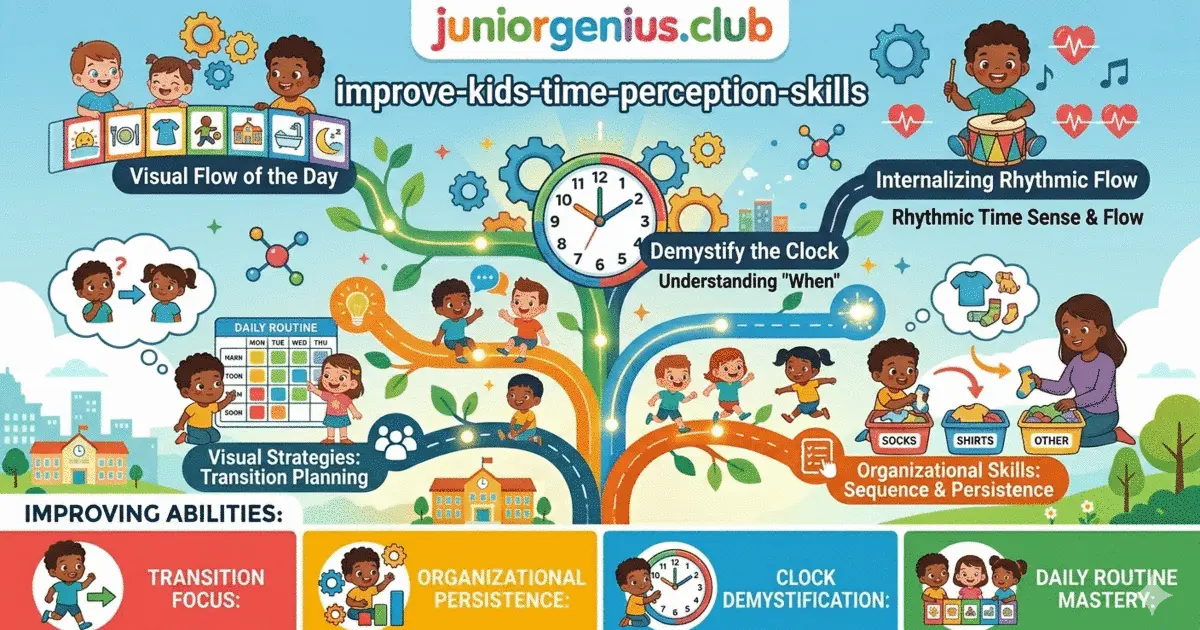
The "How" involves "scaffolding" the concept of time. We start with broad daily cycles (breakfast, nap, bedtime) and gradually move to smaller units (hours, then minutes). Visual cues are essential. A child can't "see" a minute, but they can see a sand timer running out or the hand of a clock moving. These visual anchors help the brain "map" the abstract concept of duration onto a physical change. This is the beginning of "future-thinking"—the ability to imagine and prepare for events that haven't happened yet.
Time perception also involves "rhythm." Developing an internal metronome through music and rhythmic play helps the brain "keep time." When a child claps to a beat, they are practicing the "unitization" of time—breaking it down into equal, predictable parts. This is the same logic used to understand the "ticks" of a clock. By combining rhythmic play with visual clock-reading, we are providing a multisensory approach to mastering the fourth dimension.
3. Minimization Strategies: Making Time Visible
To help your child develop a strong sense of time, you need to provide clear, consistent "temporal anchors" in your daily life. Here are some strategies:
- Create a Visual Schedule: Use pictures to show the order of the day. This helps the child see the "timeline" of their life and reduces the anxiety of the unknown.
- Use Visual Timers: Sand timers, kitchen timers, or digital countdowns are perfect for "showing" how much time is left. Watch the timer together and say, "Look, the time is almost gone!"
- The "Beat the Timer" Game: Use a timer to make chores fun. "Can we put all the blocks away before the timer beeps?" This builds awareness of duration and effort.
- Narrate the Clock: Point to a big analog clock. "See the big hand? When it gets to the 6, it's time for our snack." This starts to build the connection between the symbol and the event.
By making time a visible and predictable part of your home, you are giving your child the security and confidence to move through their day with ease.
4. Alternatives: Offline & Online
Temporal awareness can be built through many different activities that involve sequence and duration.
Offline Activities
Sun Shadows: On a sunny day, place a stick in the ground and mark where the shadow falls. Check it again an hour later. This is a "natural clock" that shows the slow, steady movement of time.
The "One Minute" Challenge: Have everyone sit perfectly still and quiet for exactly one minute. This helps the child "feel" the duration of a minute without any distractions. It's often surprisingly long!
Sequence Storytelling: Use "First, Then, Last" cards to tell a story or describe a daily routine. This reinforces the concept of temporal order and logical flow.
Online Alternatives (Kids Scroll)
Digital games can provide a safe, interactive way to experiment with the hands of a clock and learn the basic concepts of "hours" and "minutes."
What time is it?
Help your child master the clock and build their temporal awareness with our 'Guess the Time' game on Kids Scroll. It's a fun and encouraging way to introduce the concepts of hours and minutes.
Mastering time is mastering life. By helping your child grasp the concept of "When?" today, you are giving them the organizational skills and peace of mind they need to succeed tomorrow. 🌟
Frequently Asked Questions
At what age can kids tell time?
Most children can start understanding the basic concepts of 'day' and 'night' around age 2. Digital clock reading often starts around age 5-6, while analog clock reading (which is harder) usually happens around age 7-8.
Why is my child so resistant to 'leaving'?
It's likely because they don't have a sense of duration. The 'end' of play feels abrupt and permanent. Using visual timers and 'before and after' language can help them prepare for the transition.
Is an analog clock better than a digital one for learning?
Yes. An analog clock provides a spatial representation of time—you can actually see the 'slice' of the hour passing. This is much better for building an intuitive sense of duration.
How can I teach the concept of 'Yesterday' and 'Tomorrow'?
Use a calendar with pictures. 'Yesterday we went to the park (cross it out). Today we are at home. Tomorrow we will go to Grandma's house (point to the picture).' This makes the abstract timeline concrete.