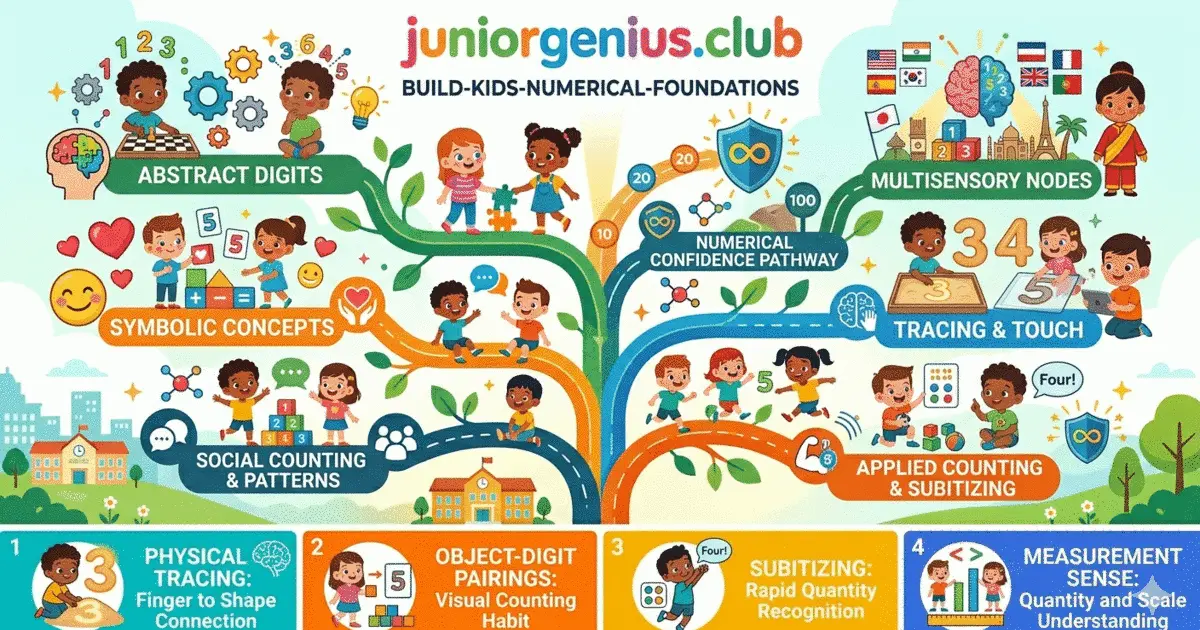
Numerical Foundations: Making Counting a Physical and Visual Habit
🔢 Numbers are the language of logic, but for a toddler, they are often just abstract sounds. "One, two, three" can be recited like a song without any understanding of what those words actually represent. Building a strong numerical foundation is about bridging the gap between the abstract symbol and the concrete quantity. It's about helping the child "feel" the numbers through physical and visual habits.
1. The Problem: The "Rote Counting" Trap
The core problem in early numeracy is the "Rote Counting" trap. Many children can count to ten or even twenty by memory, but they lack "one-to-one correspondence"—the ability to match one number word to one physical object. If you ask them to give you "three" blocks, they might just hand you a random handful while still counting. This disconnect between the word and the quantity is a major hurdle for future mathematical success.
When a child lacks a solid numerical foundation, math becomes a source of anxiety rather than a tool for exploration. In later years, they might struggle with concepts like addition, subtraction, and place value because they haven't "internalized" the basic building blocks of number sense. This can lead to a lower Intelligence Quotient (IQ) in the area of logical-mathematical reasoning. Without a "concrete" understanding of numbers, the world of mathematics remains a collection of meaningless rules and formulas.
Additionally, the digital world often presents numbers in a purely symbolic way. Apps that simply flash digits on a screen without connecting them to a physical or visual quantity do very little to build true numeracy. To establish a strong foundation, we must move beyond "watching" numbers and into "handling" them—making counting a multisensory experience that involves sight, sound, and touch.
2. The "Why" and "How": The Science of Number Sense
The "Why" behind numerical foundations lies in "number sense"—the intuitive understanding of numbers and their relationships. This involves "subitizing" (the ability to see a small group of objects and know how many there are without counting) and understanding "magnitude" (the difference between 'more' and 'less'). These are the foundational skills that allow us to estimate, compare, and eventually perform complex calculations.
The "How" involves the "Triple-Code Model" of the brain. The brain processes numbers in three ways: the verbal code (the name of the number), the visual code (the Arabic digit), and the magnitude code (the actual quantity). True numeracy requires the seamless integration of these three codes. By tracing a number (visual and motor), hearing its name (verbal), and counting objects (magnitude), we are strengthening the neural connections between these different areas of the brain.
Physical tracing is particularly powerful. When a child traces the shape of a '3', they are using haptic learning to build a "muscle memory" of the symbol. This makes the symbol easier to recognize and eventually to write. By combining this tracing with counting exercises, the child begins to understand that the shape '3' *means* three distinct things. This is the "Aha!" moment where abstract math becomes a concrete tool.
3. Minimization Strategies: Making Math a Daily Habit
To help your child build a strong numerical foundation, you need to integrate counting into your everyday routines. Here are some strategies:
- One-to-One Correspondence Play: Give your child a set of objects (like cereal pieces or buttons) and a muffin tin. Ask them to put "one" item in each hole while counting out loud. This physically enforces the connection between one word and one object.
- Number Tracing: Use sand, shaving cream, or a digital tracing tool to practice the shapes of numbers. This haptic experience makes the symbols more "real" and memorable.
- "Which has More?" Game: Show two groups of objects (e.g., three apples and five apples) and ask which one has "more." This builds the concept of magnitude without needing to know the exact numbers yet.
- Cooking with Numbers: Let your child help you measure ingredients. "We need two scoops of flour." This shows them that numbers have a practical utility and a physical volume.
By making numbers visible and tangible, you are removing the mystery and building a child who is comfortable and confident in the world of math.
4. Alternatives: Offline & Online
Numeracy can be built through many different interactive and sensory experiences.
Offline Activities
The "Number Walk": Go for a walk and look for numbers on house doors, signs, or license plates. This is a great way to practice digit recognition in a real-world context.
Physical Counting: Have your child jump three times, or clap five times. This connects the number word to a physical sensation and a temporal duration, deepening their understanding of quantity.
Board Games with Dice: Games like 'Hi Ho! Cherry-O' or even a simple homemade board game with a die are excellent for practicing one-to-one correspondence and simple addition.
Online Alternatives (Kids Scroll)
Digital tools can provide a clean, repetitive way to practice tracing and counting with immediate, encouraging feedback.
Let's Learn to Count!
Build your child's numerical foundations through interactive tracing and counting exercises in our 'Learn Numbers' game on Kids Scroll. It's a fun and focused way to make numbers 'click' in a safe, ad-free space.
Numerical literacy is the key to unlocking the mysteries of the universe. By helping your child build their foundations today, you are giving them the logic and clarity they need to succeed tomorrow. 🌟
Frequently Asked Questions
When should a child start learning to count?
Most children can start reciting number names by age 2, but true understanding of quantity and one-to-one correspondence usually develops between ages 3 and 4.
My child skips numbers when counting. Is that okay?
Yes, it's very common! They are still learning the sequence. Just gently model the correct sequence for them. Use games like 'Learn Numbers' on Kids Scroll to reinforce the order through play.
What is subitizing?
Subitizing is the ability to instantly recognize the number of objects in a small group (usually up to 5) without actually counting them. It's a key sign of strong number sense.
Are digital number games better than flashcards?
Interactive games are often better because they allow for 'haptic' learning (tracing) and immediate feedback, which flashcards lack. The key is to keep the digital time active and focused.