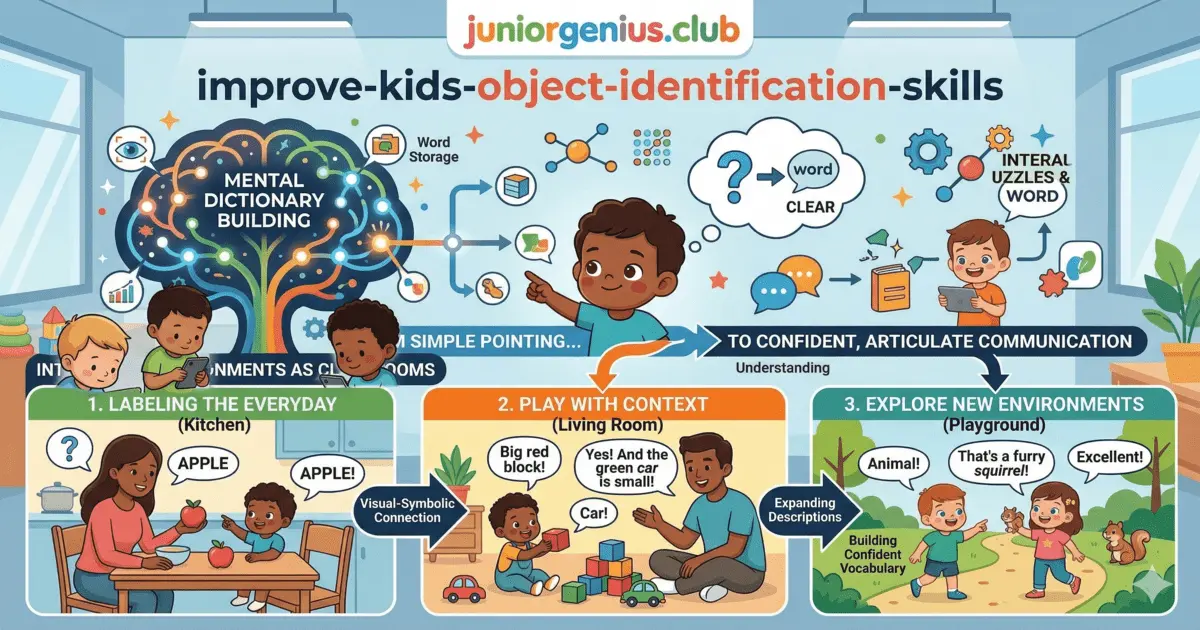
Object Identification: Building Early Vocabulary Through Visuals
🐶 Every word a toddler learns is a window into a new part of their world. Object identification—the ability to recognize an object and associate it with its name—is the first major hurdle in language acquisition. This skill isn't just about speaking; it's about the cognitive connection between a visual image and a symbolic sound. However, in a world dominated by abstract icons and fast-moving images, many children face challenges in building a robust and diverse "mental dictionary."
1. The Problem: The "Point and Grunt" Phase and Digital Delay
A common problem parents face is the prolonged "point and grunt" phase. While pointing is an important developmental milestone (showing joint attention), it should eventually be replaced by naming. The "Object Identification Gap" occurs when a child can visually recognize an object but lacks the neural pathway to retrieve its name. This can be due to a lack of "rich naming" in their environment—where parents might use generic terms like "that thing" or "your stuff" instead of specific names.
The digital world can also contribute to this delay. While many children's apps claim to teach vocabulary, they often lack the "relevance" of real-world objects. A child might learn the word for "zebra" from a screen but fail to name the "spatula" in their kitchen. This creates a disconnect between digital learning and real-world application. Furthermore, the lack of "back-and-forth" interaction in many digital experiences means the child is a passive observer rather than an active identifier.
If a child struggles with object identification, it can lead to frustration (EQ) and a slower start in social integration (SQ). They cannot communicate their needs or share their interests with others if they lack the words for the objects around them. This is why early vocabulary building is one of the most significant predictors of future literacy and academic success.
2. The "Why" and "How": The Brain's Naming Network
Building vocabulary is a whole-brain activity. The visual cortex identifies the object, and Wernicke's area in the temporal lobe processes the word's meaning, and Broca's area in the frontal lobe coordinates the speech to say the name. This complex naming network is built through thousands of "mapping" events in early childhood. Mapping is the moment a child sees an object and hears its name simultaneously.
The "How" of this process is called "fast mapping." Toddlers are uniquely capable of learning a new word after just one or two exposures. However, this fast mapping requires the child to be actively engaged. If they are just listening to a screen in the background, the brain doesn't "lock in" the association. Active identification—where the child is asked "What is this?"—is what truly strengthens these neural bonds.
Object identification also builds the foundation for categorization and logic. To know that a "collie" and a "poodle" are both "dogs," the child must first be able to identify each as an object. This progression from specific to general is a key cognitive developmental stage. The more specific objects a child can identify, the more complex their mental world becomes.
3. Minimization Strategies: Naming the World
To help your child build a rich mental dictionary, you need to turn their everyday world into a classroom. Here are some strategies for "rich naming":
- The "What's That?" Walk: Take a walk around your neighborhood and name everything you see. "Look, there's a *fire hydrant*," or "See the *dandelion*." Don't simplify the language; toddlers love complex words!
- Echo and Expand: When your child points to something and grunts, name it for them and then expand. "Oh, you want the *apple*? This is a *red, crunchy apple*." This reinforces the name and adds more descriptive data.
- Picture Book "Find It": Instead of just reading the story, ask your child to find specific objects in the illustrations. "Where is the *butterfly*?" "Can you find the *watering can*?"
- Interactive Identification: During mealtime or bath time, ask "What is this?" for common items like a spoon, a towel, or a rubber duck. This active retrieval is much more powerful for the brain than passive listening.
Consistency and variety are key. By naming the objects in their immediate environment, you are making their world more understandable and less frustrating.
4. Alternatives: Offline & Online
Making vocabulary building a game ensures that it stays fun and engaging for both you and your child.
Offline Activities
The "Mystery Bag": Put several familiar objects in an opaque bag. Have your child reach in, feel an object (without looking), and try to name it. This uses tactile identification to reinforce the visual/verbal connection.
Sorting by Name: Gather a group of toys and ask your child to "Bring me the *lion*" or "Where is the *airplane*?" This tests their ability to identify an object from a group based solely on its name.
I Spy: Play a simple version of "I Spy" using colors or basic descriptions. "I spy with my little eye, something *green*." This encourages the child to scan their environment and identify objects that match the criteria.
Online Alternatives (Kids Scroll)
When using digital tools, prioritize those that encourage active identification and provide clear, high-quality visuals.
What is that animal?
Build your child's mental dictionary with our interactive 'What is it?' quiz on Kids Scroll. It's a safe, ad-free way to practice naming and identification!
Every new word is a new tool for your child to understand and interact with their world. By prioritizing object identification, you are setting them on the path to becoming confident and articulate communicators. 🗣️
Frequently Asked Questions
When should I worry about my child's vocabulary?
While every child develops at their own pace, most toddlers have a 'vocabulary burst' between 18 and 24 months. If you are concerned, focus on active naming games on Kids Scroll and consult your pediatrician.
Do baby signs help or hinder speaking?
Research shows that baby signs actually help speaking! They provide a bridge for communication before the vocal cords are ready, reducing frustration and encouraging the desire to name objects.
Should I use 'baby talk'?
It's better to use 'parentese'—a higher-pitched, slower, and more melodic way of speaking—but with real words. Avoid nonsense words and instead use clear, correct names for objects to help their mapping process.
How can I encourage my child to say the word?
Give them 'wait time'. After asking 'What is this?', wait 5-10 seconds before giving the answer. This gives their brain time to retrieve the word from their mental dictionary.