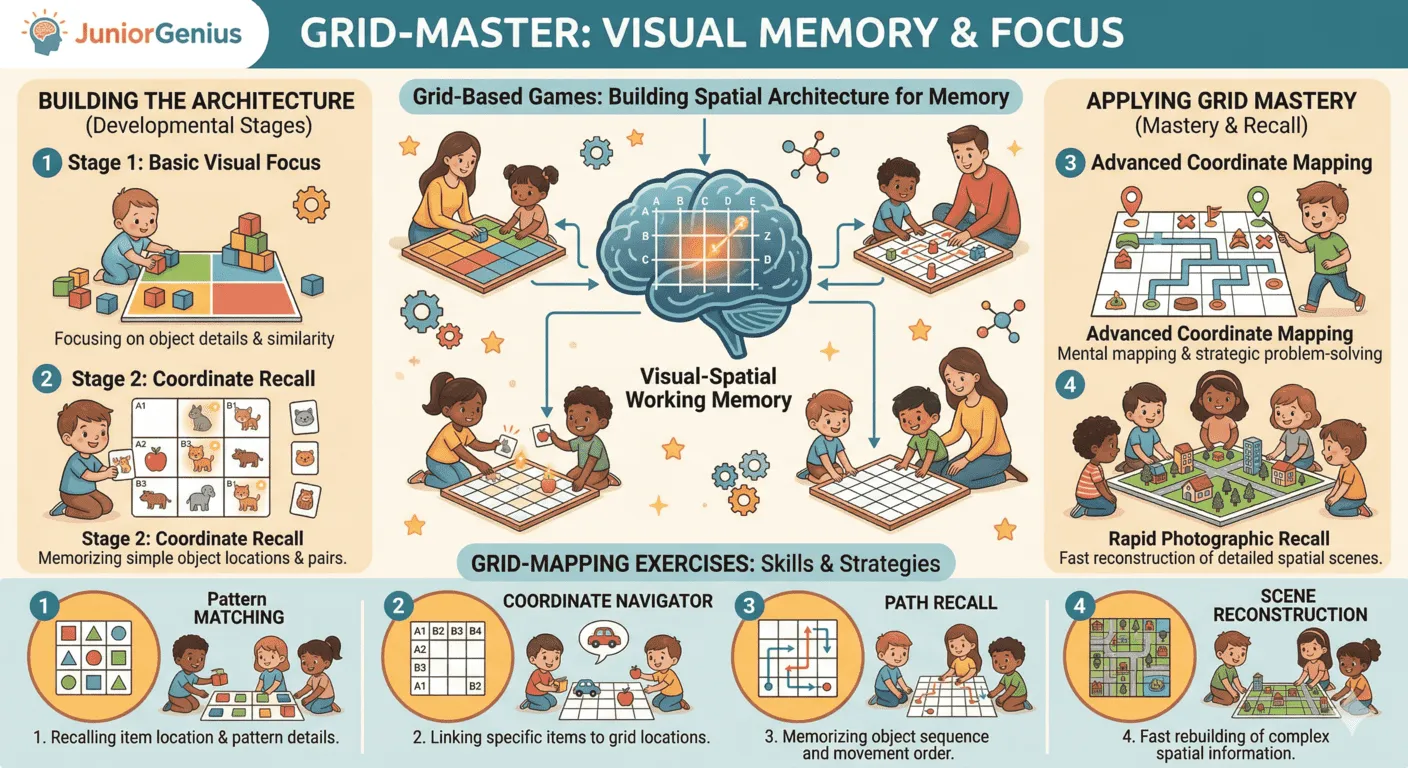
The Grid Master: Advanced Visual Memory Strategies
🖼️ Memory is not just about *what* you see, but *where* you see it. For a child, mastering the "grid"—the ability to map objects to specific spatial coordinates—is the secret to unlocking advanced visual recall. This "Grid Master" skill is the foundation for photographic memory, allowing the brain to organize and retrieve visual information with incredible speed and accuracy.
1. The Problem: The Floating Image
The problem many children face is "floating memory." They can remember that they saw a red apple, but they can't remember where it was. When images aren't anchored to a specific location, they are easily lost or confused with other memories. This lack of spatial anchoring can lead to a "blurred" mental record, making it difficult to follow multi-step visual instructions or find misplaced items. This can negatively impact their IQ (Intelligence Quotient) and their photographic memory potential.
Without the practice of grid-based mapping, a child's "visual-spatial working memory" remains underdeveloped. Working memory is the brain's "scratchpad." If the scratchpad is disorganized, the brain has to work much harder to keep track of information. This "cognitive load" can lead to mental fatigue and a lack of focus in academic tasks. A child who struggles to map a grid may find it harder to learn the positions of letters on a page or numbers on a clock face.
Furthermore, an inability to master spatial recall can impact a child's confidence in their own mind. If they consistently "forget" where things are, they may begin to doubt their intelligence. This fragility can impact their AQ (Adversity Quotient), making them more likely to give up on tasks that require sustained mental effort. Grid-mastery is the first step toward building a "secure" memory that the child can trust.
2. The "Why" and "How": Spatial Coordinate Mapping and Neural Anchoring
Why is a grid so much better than a random pile for memory? It's about "Coordinate Mapping." By placing objects in a grid, we are providing the brain with a set of "address labels" (e.g., top-left, bottom-right). The brain finds it much easier to store and retrieve an object when it has a specific spatial address. This strengthens the pathways between the hippocampus (memory) and the parietal lobe (spatial reasoning).
The "How" involves "Visual Chunking." A grid allows the brain to break down a complex scene into smaller, manageable "chunks." Instead of trying to remember 12 items, the brain remembers 4 rows of 3. This reduction in cognitive load allows for much higher levels of recall and precision. Every successful match in a grid-based game is a win for the brain's "indexing system."
Additionally, grid mastery builds "sustained visual attention." To remember the positions of multiple items, the child must scan the entire grid and hold the information in their mind while they look for a match. This constant "refreshing" of the mental image is a high-intensity workout for the visual cortex, building the foundational skills needed for deep focus and photographic recall.
3. Minimization Strategies: Anchoring the Mind
You can sharpen your child's visual memory and grid-mastery with these simple strategies:
- The "Tray Memory" Game: Place 3 or 4 familiar objects on a tray in a simple grid (e.g., 2x2). Let your child look for 10 seconds, then cover the tray and ask them to name the objects and their positions. "What was next to the car?"
- Grid Clean-Up: Use a muffin tin or an ice cube tray for small toy sorting. This provides a physical "grid" that forces the child to think about spatial coordinates as they organize their treasures.
- "I Spy" the Grid: While looking at a patterned rug or a tiled floor, play "I spy something in the third square." This turns the environment into a giant memory-mapping game.
- Drawing on a Grid: Give your child paper with large squares. Ask them to draw a different simple shape in each square. This connects the motor act of drawing directly to spatial coordinates.
These activities move the child from "floating memories" to "anchored recall," sharpening their visual minds and their organizational intelligence.
4. Alternatives: Offline & Online
Mastering the grid requires both physical spatial exploration and clear, high-repetition digital mapping. Resources on Kids Scroll are ideal for this memory-building journey.
Offline Activities
Classic Memory Card Games: Playing with physical cards laid out in a grid is the gold standard for memory training. It requires patience, focus, and constant spatial updating.
"What's Missing?": Lay out a grid of objects, have your child close their eyes, and remove one. Can they identify the missing item and the *spot* where it was? This targets both recall and spatial mapping.
Treasure Map Play: Create a simple grid-based map of a room or the garden. Hide a "treasure" in one of the grid squares and have your child find it. This is advanced spatial coordinate logic!
Online Alternatives
Digital memory games can provide a wide variety of grid sizes and image sets that adapt to the child's level, providing the perfect "difficulty curve" for memory mastery. Kids Scroll offers the perfect entry for this.
Spot the Pair!
Challenge your child's visual memory and grid-mastery with our interactive "Spot the Pair" game. It's safe, fun, and ad-free!
Spot the Pair: This game on Kids Scroll is a brilliant way to practice grid-based memory. Children must find matching pairs of emojis hidden behind tiles in a grid, forcing them to map the locations of varied items and update their mental records with every move. It's an ad-free, high-engagement way to reinforce spatial mapping and build the "visual-spatial working memory" that is so critical for advanced cognitive development and photographic recall. 🌟
When a child masters the grid, they master their own mind. Let's keep those memories anchored! 🌟
Frequently Asked Questions
At what age can kids start playing memory games?
Simple 2x2 grids can be introduced as early as age 2. By age 4, many children can handle 3x4 or even larger grids as their visual memory and focus expand.
My child gets frustrated when they can't find a pair. What should I do?
This is a great moment for building AQ (Adversity Quotient). Help them "talk through" the grid. "We saw the apple in the top row... let's check there again." This makes it a collaborative puzzle rather than a test.
Is photographic memory real?
While true "eidetic" memory is rare, the ability to build incredibly clear and accurate "mental pictures" is a skill that can be significantly enhanced through early visual-spatial training.