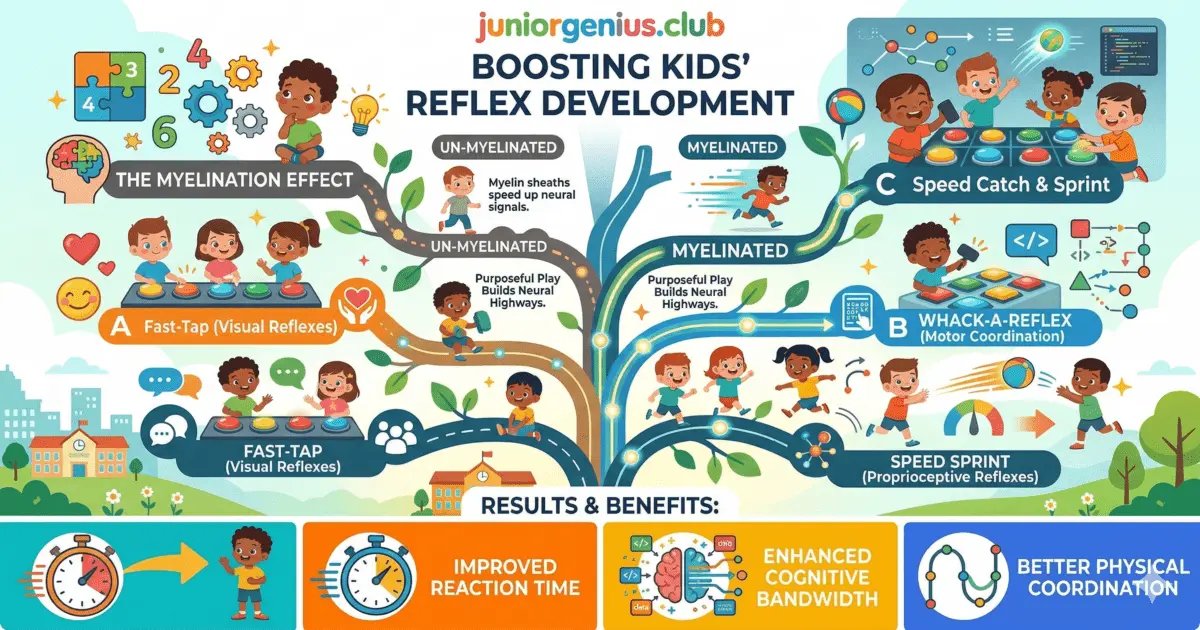
Reflex Development: Why Speed-Based Play Builds Brain Connections
🚀 When we think of "reflexes," we often think of athletes or professional gamers. However, reflex development is one of the most foundational aspects of early childhood growth. A child's ability to react quickly to an external stimulus is not just a physical trait; it is a direct window into the efficiency of their central nervous system. In this article, we explore why speed-based play is a "superfood" for the developing brain.
1. The Problem: The Sedentary Slow-Down
The problem modern children face is an increasingly "passive" environment. Many entertainment options for toddlers are slow-moving, narrative-driven, or purely observational. While storytelling is great for EQ, it does little for the physical wiring of the brain. When a child's environment lacks "fast" stimuli, their neural processing speed can begin to lag. This isn't about intelligence; it's about the "bandwidth" of the brain-body connection.
A child with slow reflexes may struggle in several areas. Physically, they may be more prone to minor accidents, as they can't put their hands out quickly enough to break a fall. Socially, they might find it hard to join in fast-paced games on the playground, leading to feelings of exclusion or frustration. In the classroom, slow processing can make it difficult to follow multi-step instructions or keep up with the pace of a group activity. This "sedentary slow-down" can have a ripple effect on a child's confidence and their Adversity Quotient (AQ).
Furthermore, without regular "speed training," the brain's ability to filter relevant information from background noise remains underdeveloped. A reflex is essentially a decision: "I see X, therefore I must do Y immediately." If a child's brain takes too long to reach that conclusion, the window of opportunity for action closes, leading to a sense of disconnect from their surroundings.
2. The "Why" and "How": Myelination and Neural Efficiency
What is actually happening in the brain when a child plays a speed-based game? The "Why" is found in a process called myelination. Myelin is a fatty substance that wraps around the axons of neurons, acting like insulation on an electric wire. The thicker the myelin, the faster the electrical signal travels. Rapid-response play encourages the brain to lay down more myelin on the pathways connecting the visual cortex to the motor cortex.
The "How" involves the "Sense-Process-Act" loop. 1. **Sense:** The eyes see a moving object (visual stimulus). 2. **Process:** The brain identifies the object and calculates its trajectory. 3. **Act:** The brain sends a signal to the hand to move. By shortening the "Process" phase through repetition and play, we are essentially upgrading the brain's "processor."
This increased neural efficiency doesn't just apply to physical movements. Research suggests that faster reaction times in childhood are correlated with higher scores in fluid intelligence and better executive function. When the brain can "clear" simple physical tasks quickly, it frees up cognitive resources for more complex problem-solving. Speed-based play is, in many ways, an IQ booster in disguise.
3. Minimization Strategies: Incorporating Fast-Paced Moments
You don't need a high-tech lab to help your child develop faster reflexes. Here are some simple minimization strategies to keep their neural pathways firing:
- The "Drop" Game: Hold a small, soft toy or a ball at your child's eye level. Tell them you will drop it "sometime soon." Their goal is to catch it before it hits the ground. This trains focused attention and rapid hand-eye coordination.
- Red Light, Green Light: This classic game is a powerhouse for reflex control. It forces the child to switch between "all-out speed" and "total stillness" instantly, strengthening the inhibitory control centers of the brain.
- Balloon Bumping: Keep a balloon in the air using only your hands. Because balloons move unpredictably and relatively slowly, they provide a perfect "beginner level" for reflex training, allowing the child to track and react without being overwhelmed.
- Stopwatch Challenges: Give them simple tasks (like "touch the blue chair") and see if they can do it "faster than last time." Focusing on beating their own record builds a healthy AQ and a love for self-improvement.
The key is to keep these sessions short (5-10 minutes) and high-energy. Reflex training should feel like a burst of fun, not a chore.
4. Alternatives: Offline & Online
Balancing physical speed with digital accuracy creates a well-rounded motor skill set. Exploring resources on Kids Scroll can provide the structured repetition needed for mastery.
Offline Activities
Bean Bag Toss: Throwing and catching bean bags. Unlike balls, bean bags don't bounce, so the child has to be "on it" to make the catch. You can vary the speed and angle as they improve.
Bubble Popping: Blow bubbles and have your child pop them using only their index finger. This requires them to track moving targets and execute a precise, quick movement before the bubble drifts away.
Shadow Tag: On a sunny day, try to "step" on each other's shadows. This requires constant movement, rapid changes in direction, and quick footwork.
Online Alternatives
In a controlled digital environment, reflex games can provide a high volume of stimuli in a short amount of time, which is excellent for neural "wiring." Kids Scroll offers perfect entries for this.
Blast Off with Rocket Burst!
Challenge your child's reaction time with our high-speed Rocket Burst game. It's fast, fun, and completely ad-free!
Rocket Burst: This game is specifically designed for reflex development. Rockets zoom across the screen at varying speeds, and the child must tap them to make them "burst." It requires intense visual focus and rapid tapping. As the game progresses, the rockets move faster and appear in greater numbers, pushing the child's reaction time to new levels. It's a thrilling, ad-free way to build those critical brain connections while having a blast. 🌌
Every "tap" and every "catch" is a win for your child's developing brain. Let's keep those reflexes sharp and those connections strong! 🌟
Frequently Asked Questions
Are fast-paced games too overstimulating for toddlers?
It depends on the child and the game. Games like Rocket Burst are designed with simple visuals and no aggressive "lose" states, making them exciting without being overwhelming. Always monitor your child's mood and take breaks!
At what age do reflexes really start to develop?
Basic reflexes are present at birth, but "voluntary" reaction time begins to sharpen significantly between ages 3 and 6. This is the optimal window to introduce fun, speed-based challenges.
Can slow reflexes be a sign of a problem?
Often, "slow" reflexes are just a lack of practice. However, if you notice significant delays in multiple areas of coordination, it's always a good idea to chat with your pediatrician about developmental milestones.
Is reflex training good for focus?
Absolutely! To react quickly, a child must maintain "sustained attention." Training the brain to stay alert for a stimulus is one of the best ways to build a longer attention span.